 History
Muslim Americans in sports: achievement, access, and life beyond the game
Five Muslim American sporting stories connecting achievement with public voice, participation, coaching, and education.
Bilqis Abdul-Qaadir, the campaign to change basketball’s headgear rule, and her later coaching work.
A uniform rule can decide a sporting career before a player reaches the court. Bilqis Abdul-Qaadir's story makes that problem concrete. She had played basketball in a hijab through school and college, but a rule against headgear complicated her plans to compete professionally overseas. Her later work connects that experience with a broader question: what does access mean when an athlete must give up something important to her before being allowed to play?
Her Muslim identity is established in her own words in published reporting. This article follows her decisions and public work. It does not prescribe how another Muslim athlete should dress or resolve a similar choice.
A 2018 feature republished by Indiana State University Athletics described Abdul-Qaadir's attempt to pursue overseas basketball after she did not enter the WNBA in 2014. Her agent told her about FIBA's headgear prohibition. The article records how difficult the decision was for her and how she joined the campaign to change the rule. Indiana State account
The obstacle was not a lack of desire to compete. It lay in the conditions attached to participation. That distinction helps explain why a sporting contribution can take place outside a match: a player can expose a barrier that a results table would never show.
A reader should also preserve the difference between college basketball and international competition. Different organizations administer different competitions. Being permitted to play in one setting did not mean that Abdul-Qaadir could assume the same rule would apply when seeking work abroad.
The Institute for Human Rights and Business reported in May 2017 that FIBA had approved a new headgear rule, taking effect that October. Its account names advocacy organizations involved in sustained efforts, including Shirzanan, Athlete Ally, Human Rights Watch, and the World Players Association. It specifically connects Abdul-Qaadir's case with the campaign. IHRB account
The achievement therefore belongs to a wider effort. Abdul-Qaadir was an important participant and public example, not the sole cause of a governing body's decision. Crediting the coalition makes the change easier to understand: an athlete's experience, public advocacy, review, and institutional decision-making all contributed to the story.
The change also affected people beyond Muslim women. Religious head coverings can matter to athletes from other traditions. That wider significance is one reason this belongs in a collection about contributions to American life, even though the governing organization and competitions were international. An American athlete's experience helped make a shared access problem visible.
The 2018 account reported that Abdul-Qaadir chose not to restart her professional playing pursuit after the rule changed. That detail prevents a neat but misleading ending in which a policy victory automatically restores a lost opportunity. Years spent waiting are still years in an athlete's life.
It is possible to recognize the importance of the rule change while respecting her decision about what came next. The public does not acquire the right to demand a comeback simply because it has followed a campaign. Her subsequent work deserves attention on its own terms.
Religion News Service reporting republished by Interfaith America described the inaugural Hooping in Faith sleepaway camp in Memphis in July 2023. The report followed approximately fifty girls and young women training with Abdul-Qaadir. It connected the camp with her organization, Muslim Girls Ball Too, and recorded participants coming from a range of places. RNS/Interfaith America report
The account describes participants who wore hijab and others who did not. That small detail matters. A space organized around Muslim girls' sporting experiences need not require everyone to look alike. Coaching offers a different kind of contribution from a record or a medal: time, instruction, a place to practice, and the presence of someone who understands a familiar obstacle.
This is a dated example of the program, not a live camp listing. During this review, the organization's separate website redirected to a suspended-hosting page. We therefore do not advertise current dates, registration, fees, or places. Readers should seek a current official announcement before making plans.
For coaches and sporting organizations, the story invites a close look at the rules that determine who can participate. What is the purpose of a restriction? Who experiences it as a barrier? Is there a way to meet the sport's practical requirements while admitting more players? These are questions for the responsible governing organization and participants to work through, rather than assumptions an outsider can settle by looking at a photograph.
For young athletes, Abdul-Qaadir's history offers more than a message about persistence. It shows that a contribution may change form. A player who does not continue along an expected professional route can still affect the conditions under which others compete and learn.
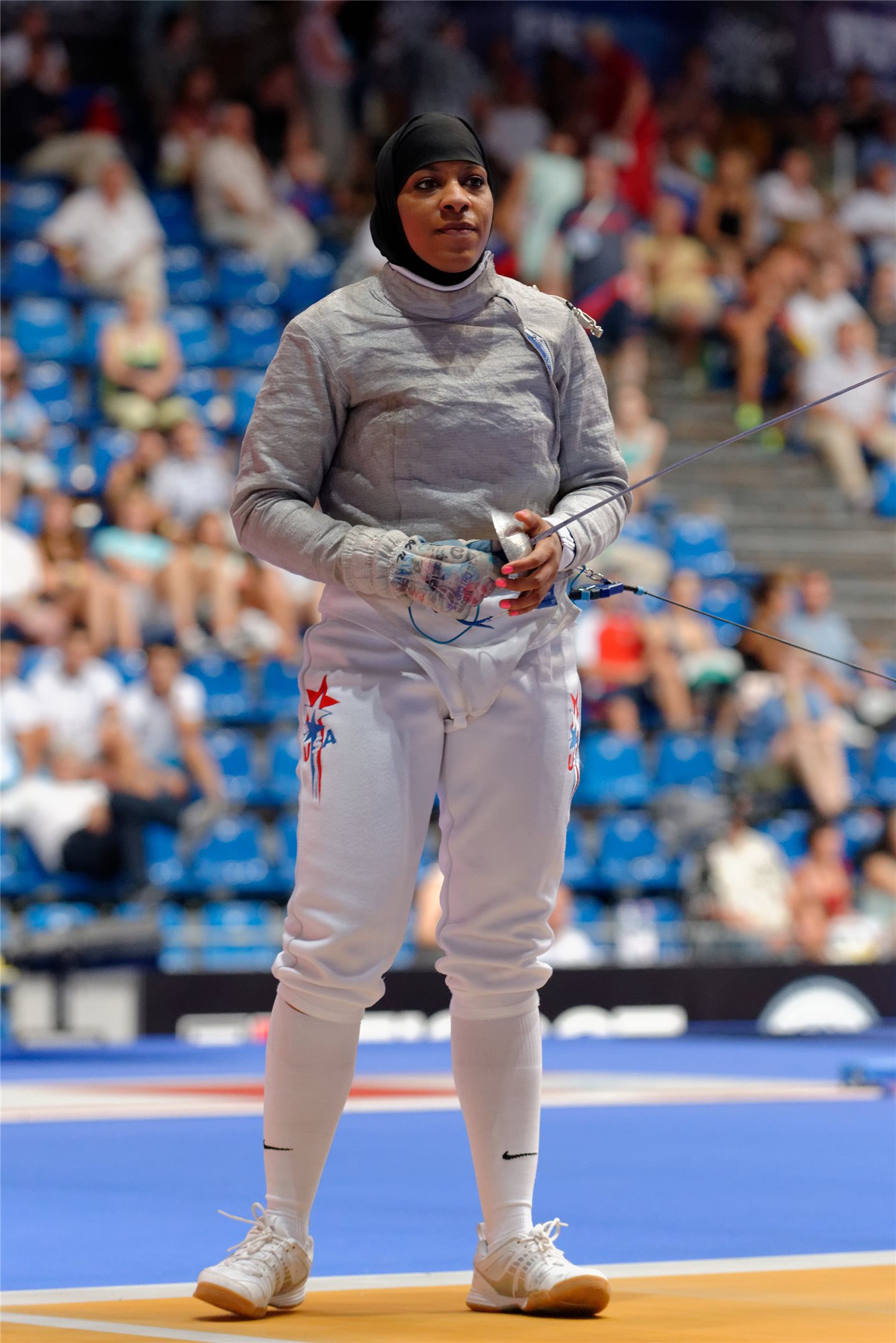
Compare this with Ibtihaj Muhammad's team medal and public work. One story includes an Olympic podium; the other includes a contested rule and a coaching environment. The sports collection brings both into view because a country's sporting life depends on who wins and on who has a fair chance to take part.
HistoryFive Muslim American sporting stories connecting achievement with public voice, participation, coaching, and education.