 History
Muslims who helped shape American science and technology
Five stories connect laboratories, skyscrapers, space exploration, and computing through the work of Muslim American scientists and engineers.
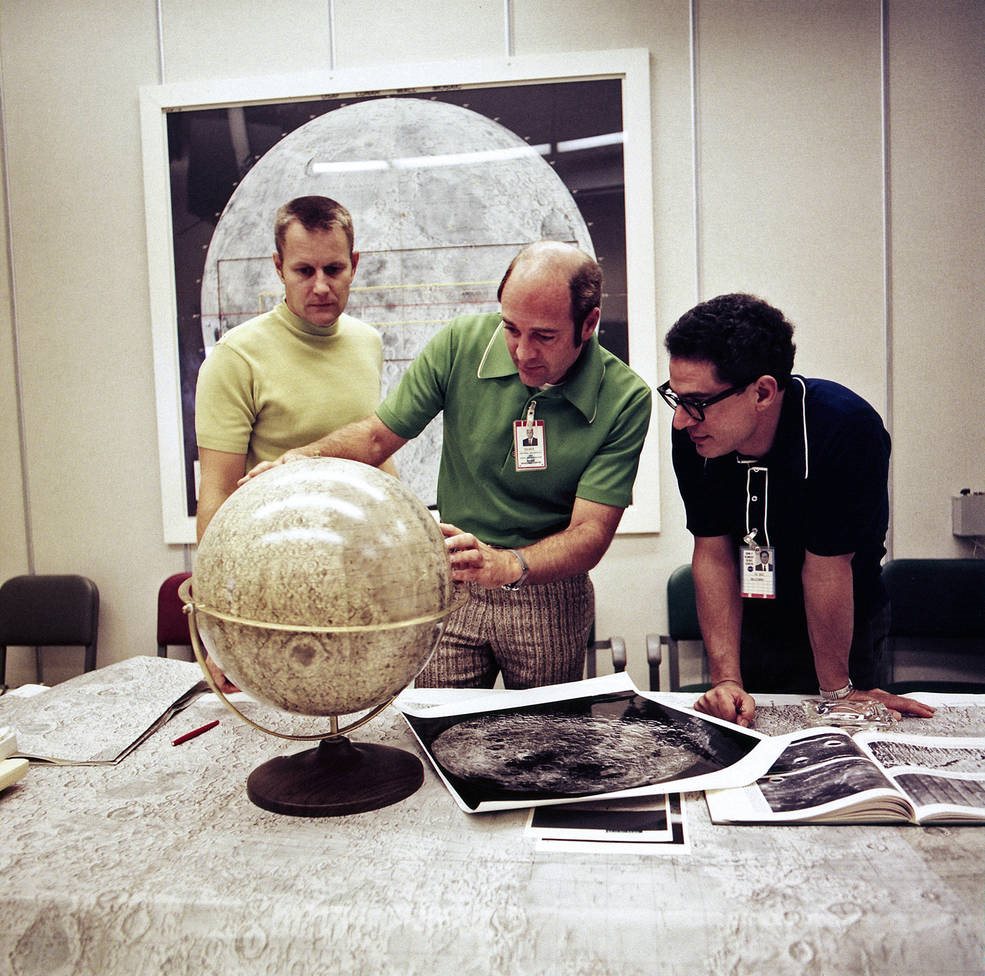
NASA training photographs reveal a geologist’s contribution to Apollo and a later career applying space observations on Earth.
One NASA photograph shows Farouk El-Baz teaching Apollo 16 astronauts through a glass partition. John Young, Thomas Mattingly, and Charles Duke were preparing for their mission while observing preflight isolation precautions. The barrier kept people apart, but the geology lesson continued.
The scene offers an unusually clear picture of an often overlooked contribution to Apollo. Reaching the Moon required propulsion, navigation, life support, and an enormous engineering organization. Learning from the journey also required people who could explain what astronauts should observe. El-Baz's work belonged to that scientific preparation.
NASA's account of the Apollo 16 countdown describes the crew's final weeks of rehearsals in 1972. Young and Duke prepared to explore the Descartes region on the surface; Mattingly would make observations from lunar orbit. The geological tasks were different, even though the crew traveled together.
The photograph of El-Baz and the astronauts makes that division of expertise tangible. Scientific instruction was not an optional lecture after flight training. It was part of the preparation continuing as the launch approached and the crew's contact with other people became restricted.
A mission photograph can therefore do more than illustrate a famous name. Its arrangement of people, equipment, and barriers documents working conditions. The caption supplies information that a generic portrait would not: who was learning, who was teaching, and why they were separated.
A second NASA history, about preparations for Apollo 17, shows El-Baz instructing command-module pilot Ronald Evans while support astronaut Robert Overmyer watches. NASA identifies the subject as lunar orbital geology.
Apollo's public imagery often concentrates on astronauts walking on the surface. The Evans photograph directs attention to the scientific work of the astronaut who remained in orbit. Looking down on a landscape can reveal relationships that are difficult to see from one location on the ground, but recognizing those relationships requires preparation.
NASA's account also describes other geologists helping astronauts practice field observations in California's San Bernardino Mountains. El-Baz was part of a broader instructional effort. Crediting him accurately means identifying his work while preserving the existence of that team.
These two documented scenes are stronger evidence than an exaggerated claim that one scientist chose everything Apollo explored. Boston University's account describes his participation in astronaut training and coordination of landing-site selection; neither role made him the sole author of the lunar program.
El-Baz joined Boston University in 1986 to direct its Center for Remote Sensing. The university describes the center's purpose as applying space technology to archaeology, geography, and geology. Its engineering profile lists research involving groundwater exploration, space photography, and geological features.
Remote sensing means studying a place through measurements obtained at a distance. The images are evidence to interpret, not answers that explain themselves. A pattern seen from above needs geological context and, depending on the question, other forms of investigation.
This continuation of his career is significant because it connects space expertise with questions about the inhabited Earth. It also makes the American institutional story larger than NASA. A university center can bring researchers from different fields into sustained contact and train students to use methods developed elsewhere.
Boston University's departmental account records NASA's recognition of the center as a Center of Excellence in Remote Sensing in 1997. That is a specific institutional distinction, rather than proof that every project associated with it reached the same level of success.
In February 2002, Boston University's newspaper reported that El-Baz had received the American Muslim Achievement Award from the Islamic Center of Southern California. The article explicitly places him in Muslim American public life and discusses his efforts to encourage understanding between Muslims and non-Muslims after September 11.
It also reports a speech at the university's Martin Luther King Jr. commemoration. His public role extended beyond specialist research to questions of religious tolerance and shared civic life. The award account is used here as documented community recognition, not as a basis for speculation about private practice.
That distinction matters for this collection. A person's birthplace, language, or name cannot establish religion. Public identification and documented participation provide a firmer basis for telling the story while respecting what the sources do and do not say.
Look at the training photographs beside a familiar lunar-surface image. The latter records an achievement at its destination. The former records some of the teaching that made a scientific achievement possible. Both belong in a history of the mission.
The photographs also suggest a good question for any museum display about exploration: whose preparation is missing from the dramatic final scene? Teachers, analysts, instrument specialists, and field geologists can become hard to see once a mission is summarized by its most famous moment.
El-Baz's documented career gives those questions a concrete American setting, from NASA training rooms to a Boston research center. Read Fazlur Rahman Khan's story for a comparable shift in perspective—from a familiar skyline to the technical reasoning and collaboration behind it.
HistoryFive stories connect laboratories, skyscrapers, space exploration, and computing through the work of Muslim American scientists and engineers.