
 History
Muslims who helped shape American science and technology
Five stories connect laboratories, skyscrapers, space exploration, and computing through the work of Muslim American scientists and engineers.
A North Carolina research career reveals how basic science, teaching, and cultural exchange can reinforce one another.
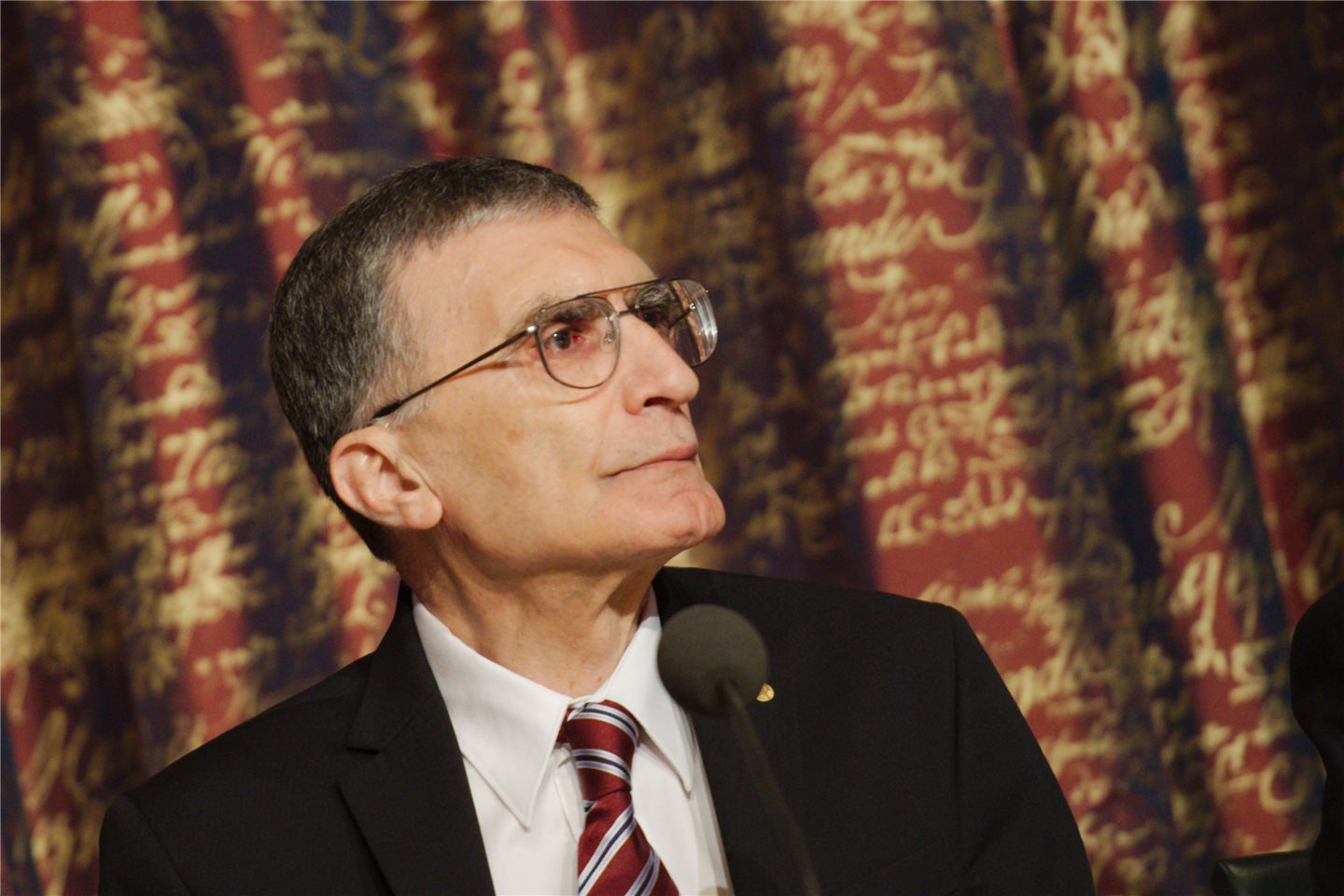
Aziz Sancar's American research career asks a question that is easy to overlook: how does genetic information survive damage? DNA is often introduced as a stable instruction book, yet the processes that protect and repair it are essential parts of the story. Sancar helped explain one of those processes, nucleotide excision repair, through work recognized by the 2015 Nobel Prize in Chemistry.
His laboratory at the University of North Carolina at Chapel Hill places that achievement within an American public university. It also places it within a longer international education and a collaborative scientific field. The useful story is not simply that a Muslim scientist won a medal. It is what researchers learned about a mechanism that had been difficult to describe.
The Aziz and Gwen Sancar Foundation's biography records his medical degree from Istanbul University in 1969 and his subsequent work as a physician in Savur. He then pursued molecular biology at the University of Texas at Dallas, earning a doctorate in 1977, followed by research at Yale. He joined UNC in 1982.
That path is not a straight progression through one institution. Clinical training, a period of medical practice, and a shift into laboratory investigation all belong to it. For students encountering his biography, the change of direction may be more useful than the later list of honors.
The foundation account also identifies DNA repair, the cell cycle, and the biological clock among his research interests. Those subjects overlap, but they are not interchangeable. A profile that treats them as one discovery misses the range of questions pursued over a long career.
UNC's description of nucleotide excision repair explains a process in which damaged DNA segments are removed and replaced. Its value lies in turning an apparently general function—repair—into a sequence that can be investigated at the molecular level.
Consider the difference between knowing that a damaged text can be corrected and knowing how the damaged passage is located, removed, and restored. The analogy is only an aid to understanding. Cells do not read with intention. But it helps explain why identifying the steps matters as much as naming the final result.
UNC Lineberger's research profile connects this work with understanding damage caused by carcinogens and the resistance of tumors to chemotherapy and radiation. These are research connections, not a claim that Sancar discovered a universal cancer cure. A basic mechanism may inform many investigations without itself becoming a treatment.
The 2015 Chemistry Nobel was shared with Tomas Lindahl and Paul Modrich. UNC's 2025 retrospective places Sancar's work alongside theirs and describes him continuing to teach and conduct research a decade after the award.
Awards often compress a long history into a single year. Reading backward from that year can make earlier experiments look inevitable. Reading forward from the laboratory questions gives a different picture: researchers did not begin with knowledge of which results would eventually attract a prize.
The shared award also matters for attribution. DNA repair is not the achievement of one laboratory or one repair pathway. Distinguishing the researchers' contributions preserves the scientific structure of the story and prevents a celebration from becoming misleading.
A 2015 report in The Peninsula, drawing on an interview in the Turkish press, quotes Sancar explicitly identifying himself as Muslim. It discusses remarks around his recognition by Chapel Hill. That reporting supplies evidence for his inclusion in a Muslim American collection.
It should be used narrowly. A published statement establishes how a person identified himself; it does not license speculation about private religious practice or suggest that every research decision followed from faith. Nor does a scientist's religious identity make a laboratory result more or less valid.
This distinction is especially helpful for a site about Muslim life in America. Biography can include religion while explaining scientific work through methods, evidence, institutions, and collaboration.
UNC's 2025 account also describes Sancar's investment in Carolina Turk Evi, a center connected with Turkish graduate students and visiting scholars. That is a form of contribution different from publishing research: helping sustain the social conditions in which students and scholars can live and work.
The foundation's public materials provide a route into this educational and cultural work. They should be read as the organization's own account, rather than as an independent assessment of its impact. A reader can explore both the scientific career and the community institution without assuming one is merely an extension of the other.
For a research project, create two columns. In the first, record laboratory questions and associated publications. In the second, record teaching and cultural activities. Then identify which source supports each entry. This exercise shows how much a short Nobel biography leaves out and keeps professional and civic achievements distinct.
Sancar's story connects naturally with Ahmed Zewail's experiments. Together, they show why American scientific history includes laboratories built by people whose education and identities crossed national borders, and why the strongest account begins with the work itself.
HistoryFive stories connect laboratories, skyscrapers, space exploration, and computing through the work of Muslim American scientists and engineers.