DREAM of Detroit: housing, memory, and neighborhood development
A close look at DREAM of Detroit’s housing rehabilitation, oral-history work, and plans for shared neighborhood infrastructure.
Follow documented local histories from early meeting rooms to mosques, schools, and community centers, with unresolved dates clearly identified.
Charlotte's Muslim history is visible in ordinary places: homes, a school gym, a former church, classrooms, and community halls. The record does not describe one congregation steadily becoming the whole city's community. It describes several institutions developing along different paths. Their names can sound similar, so keeping each organization's story separate is essential to understanding the chronology.
This account draws on congregational histories, Levine Museum of the New South, and archived Pluralism Project research. The archives capture useful details from the early 2000s; they are not current directories. Some dates conflict, and those disagreements remain visible below rather than being resolved through guesswork.
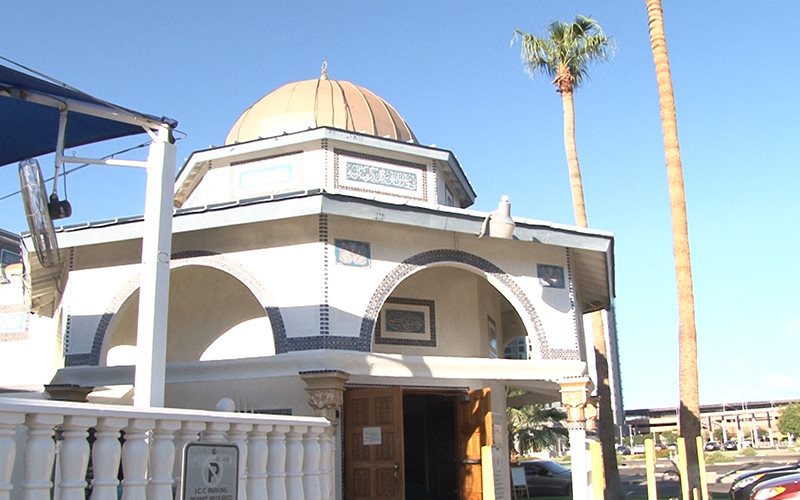
Levine Museum dates the opening of the Islamic Center of Charlotte to 1988. Its account describes a former church on Progress Lane becoming the Islamic Society of Masjid Al-Islam, followed by the ICC name in 1992. The building at 1700 Progress Lane remains the physical anchor of that story.
Separately, Masjid Ash-Shaheed's own history begins in spring 1989, when families organized Charlotte Masjid of Al-Islam. Early meetings took place in homes, then in the gymnasium at Hidden Valley Elementary School, and later on Tuckaseegee Road. The resemblance between the early organizational names is not evidence that the two histories are interchangeable.
These beginnings show how a religious community can exist before it has a permanent building. In Ash-Shaheed's case, the published sequence preserves the movement through borrowed and leased spaces. In ICC's museum account, the adaptation of an existing church connects the community's growth to a building already embedded in Charlotte's urban landscape.
Ash-Shaheed's community adopted its present name in June 1993 in memory of Mahdi Shaheed. That change is part of the congregation's own account of its identity and leadership. It also explains why an older reference to Charlotte Masjid of Al-Islam may be relevant to this community.
Levine Museum dates Charlotte Islamic Academy's establishment to 1994 and describes its early use of mosque space. The Islamic Society of Greater Charlotte, a different institution on The Plaza, places its beginnings in the 1990s on its current website. The Pluralism Project's archived ISGC profile gives 1996 as its founding year.
That ISGC archive also says families saved for fifteen years before purchasing land, without supplying a chronology that reconciles the duration with the founding date. The narrower defensible claim is that the record describes family organizing, fundraising, and a progression toward dedicated facilities. A precise land-purchase year needs stronger documentation.
The Pluralism Project's ICC profile, last updated in September 2003, describes an initial prayer group of 27 people in a rented apartment. It reports a nine-acre purchase in 1993 and the conversion of a church building. This differs from the museum's 1988 account of the Progress Lane conversion. Both sources agree on the adaptation of a church; they do not establish one consistent acquisition date.
The same archive records schooling as a major concern. It describes a small school expanding its grades while seeking money and space. This is evidence of the institution's priorities at that moment, not a current enrollment figure. Its descriptions of classroom routines and fundraising help explain why later community development involved more than additional worship space.
Ash-Shaheed records its move to 400 West Sugar Creek Road on September 15, 2006. A biography on the same site mentions construction in 2007. Those statements describe different milestones and should not be compressed into one opening date without further evidence.
Levine Museum also places ICC's purchase of land for Al-Nour Community Center in 2006 and dates completion of that center to 2020. Its account describes a gymnasium, event spaces, and outdoor recreation alongside worship. This marks a wider range of community uses in the documented institutional story.
The timeline continues with newer organizations. Pillars Mosque states that it was established in 2018 and was formerly Muslim Community Center. A reader encountering the old name in a program or photograph is seeing part of that institution's history, not necessarily a separate venue.
Progress Lane, West Sugar Creek Road, and The Plaza offer three distinct geographic anchors. They connect local Muslim history to Charlotte neighborhoods beyond the downtown skyline. These remain living community places; historical interest does not make their interiors continuously open to sightseers.
The mosque guide provides current official contact routes. Together, the histories suggest a city shaped by sustained organizing around worship, children's education, and shared facilities. They leave important questions open, including individual family experiences and the full range of local congregations. The documented chronology is a starting point for that broader history, not a claim to have exhausted it.
The Levine Museum's account of the Islamic Center of Charlotte also documents uses beyond worship. Its Al-Nour facility includes a gym and event space, offers rentals, and has served as a polling location. Those details make the contribution concrete: an institution can create rooms and infrastructure that connect religious community life with the wider city's routines. This does not establish who uses every program or measure its impact, but it identifies functions that a visitor can investigate.
The distinction matters when telling Charlotte's story. A building's size is less informative than what people can do there and how access is arranged. For any proposed visit or collaboration, contact the institution about its current arrangements. Historical descriptions are a starting point, not a booking system. Read more about everyday neighborhood contributions.
A close look at DREAM of Detroit’s housing rehabilitation, oral-history work, and plans for shared neighborhood infrastructure.
 Community
Find a public mosque visit, contact the host, and make space for a useful conversation.
Documented energy and water projects in American mosques, from ISNA’s ENERGY STAR partnership to incremental improvements in Milwaukee.