

A First Visit to Islamic Art at the Smithsonian
Explore manuscript painting, a Samanid bowl, and object histories at Washington's National Museum of Asian Art, with practical planning links.
Charles Lang Freer, the museum's 1923 opening, and the journals that helped establish Islamic art scholarship in the United States.
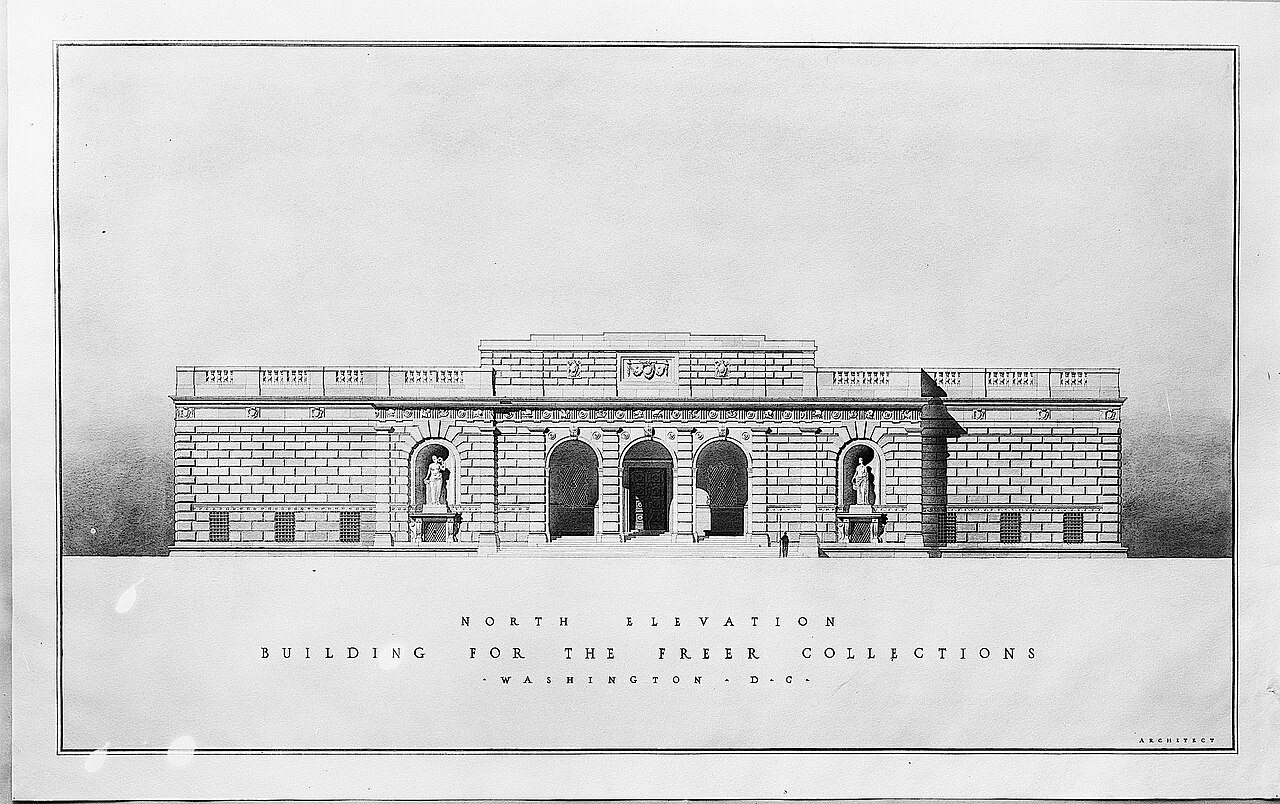
When the Freer Gallery of Art opened in 1923, visitors on the National Mall could encounter American painting alongside works from several Asian traditions and the Islamic world. The combination reflected the interests of Charles Lang Freer, whose collection became the foundation of the museum. It also established a lasting American setting for the study of objects made far beyond the United States.
Freer had made his fortune in railroad car manufacturing. His enthusiasm for James McNeill Whistler's work helped direct his attention toward Asian art. In 1906 he gave his collection to the nation, following a proposal to President Theodore Roosevelt the previous year. The museum's institutional history describes a collector concerned with relationships among objects as well as their individual qualities.
Freer worked with architect Charles Platt on a building inspired by an Italian Renaissance palazzo. The courtyard and carefully proportioned galleries were intended to support a particular experience of looking. The architecture itself was not a reproduction of an Islamic building; it was an American collector's chosen setting for works from multiple cultures.
That distinction matters. Museum design can make objects appear to belong naturally together, even when their original contexts differed greatly. A bowl, a manuscript page, and a painting may share a gallery because of the collection's history rather than because their makers ever imagined them side by side.
The Arthur M. Sackler Gallery opened in 1987, adding another major space for Asian art on the Mall. Together, the galleries form the National Museum of Asian Art. Their shared institutional history combines private collecting, public access, research, and changing approaches to interpretation.
The museum's Islamic collection overview covers manuscripts, ceramics, metalwork, and painting. Their different uses and regional histories made specialist research essential. Classifying them together did not answer questions about attribution, inscriptions, or production; those questions required a scholarly community.
The history extends beyond the galleries. The journal Ars Orientalis grew out of earlier efforts to establish Islamic art as a field of scholarly study in the United States. Its published history traces the role of Mehmet Aga-Oglu, who worked at the Detroit Institute of Arts and the University of Michigan.
Aga-Oglu founded Ars Islamica in 1934. The journal continued through 1951, with publication affected by the difficulties surrounding the Second World War. In 1954, Ars Orientalis began as a collaboration involving the Freer Gallery and the University of Michigan, extending the scope toward the arts of Asia more broadly.
The journal's history also explains the institutional arrangement that made this work possible. Agha-Oglu became the Detroit Institute of Arts' Near Eastern curator in 1929 and took a parallel University of Michigan appointment in 1932. Support associated with Freer connected the museum and university, helping preserve specialist expertise during the Depression. The inaugural Ars Islamica issue appeared in January 1934, supported by the university's Freer Research and Publication fund. This was a practical network of appointments, funding, and publication, rather than scholarship emerging automatically from the presence of valuable objects.
These publications mattered because a collection requires more than storage and exhibition. Scholars identify objects, compare inscriptions, investigate techniques, and revise dates or attributions. A journal creates a place where those arguments can be examined and challenged. The museum thus participates in producing knowledge, rather than simply presenting settled facts.
The exhibition Engaging the Senses: Arts of the Islamic World approaches objects through experiences that extend beyond sight. A Quran manuscript, for example, belongs to a history of recitation as well as calligraphy. A vessel may imply touch, food, or shared hospitality.
One featured object is a tenth-century Samanid bowl. Its inclusion encourages attention to writing, surface, and use together. A museum case protects the object but also separates it from the bodily actions for which it was made. Sensory interpretation helps visitors imagine some of those missing relationships without pretending to recreate the past completely.
The museum's provenance research resources add another necessary dimension: the routes by which works entered collections. Ownership histories can involve dealers, collectors, excavations, and changing borders. Those histories are part of the object rather than administrative details outside its meaning.
For American visitors, the Smithsonian offers both an encounter with artistic traditions and a view into how those traditions have been collected and studied here. The most rewarding questions move between the two: what did this work mean in its earlier setting, and what has its American museum life made possible—or harder—to see?
Explore manuscript painting, a Samanid bowl, and object histories at Washington's National Museum of Asian Art, with practical planning links.